Coffee isn’t just defined by its origin or roast – the genetic variety of the bean plays a huge role in how it tastes. Think of wine grapes: a Chardonnay and a Pinot Noir from the same vineyard will still taste different because of their genetics. The same goes for coffee. Certain varieties are famous for signature flavors: for example, Bourbon is often praised for its sweetness, while Geisha is celebrated for delicate, tea-like qualities. Of course, flavor isn’t only about variety; factors like where it’s grown (terroir) and how it’s processed also influence the taste. But tasting a Geisha next to a Bourbon makes one thing clear – the bean’s DNA can create a world of difference in the cup.
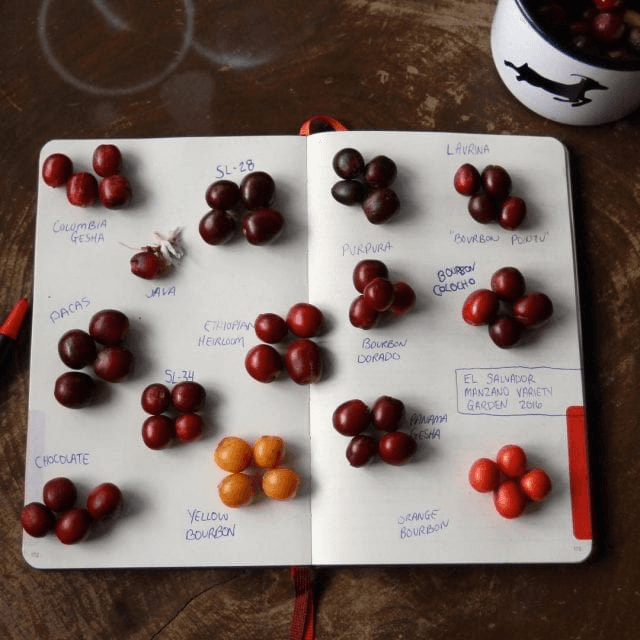
Cherries from different coffee varieties can even look different. Each variety – Geisha, Bourbon, or SL28 – carries its own unique flavors and story. For instance, some Bourbon strains have yellow or orange cherries, while others like SL28 have deep red fruit. These visual cues hint at the distinct genetic makeup that contributes to the diverse taste profiles of each variety.
In specialty coffee, knowing the variety is key. Roasters pay attention to it because it affects how the beans roast and what flavors they develop. Let’s dive into three renowned Arabica varieties – Geisha, Bourbon, and SL28 – and see why each tastes so distinct.
Geisha: Floral Elegance in a Cup
Geisha (also spelled Gesha) is the coffee world’s superstar variety, known for its stunningly floral and tea-like cup profile. Originally, this variety was a wild Ethiopian landrace from the Gesha village in Ethiopia. It remained obscure until the early 2000s, when a Panamanian farm (Hacienda La Esmeralda) cultivated it at high altitude and wowed the world by winning the 2004 Best of Panama competition. Since then, Geisha has become synonymous with coffee excellence and can fetch record-breaking prices at auction.
Flavor Profile: Often described as “perfume-like”, Geisha boasts jasmine-like florals, delicate tea notes, and bright citrus or stone fruit sweetness. In the best Geisha coffees, you might taste bergamot, peach, or mango wrapped in an elegant, silky body – a flavor experience more akin to an Ethiopian coffee or fine tea than a typical Central American coffee. No wonder many describe Geisha as “complex yet delicate” in the cup.
Origin & Story: Hailing from Ethiopia, Geisha was brought to Central America decades ago, valued for its disease resistance, but stayed under the radar until Panama’s success story. Its rise to fame in Panama showed that genetics + terroir can unlock amazing flavors – Geisha grown in Panama’s high-altitude, volcanic soil revealed the variety’s full potential (flavors reminiscent of Ethiopian heirloom coffees, but grown in Latin America). This shockingly unique profile put Geisha on every coffee professional’s map.
Growing Traits: Geisha plants are finicky. They thrive at high elevations (generally above 1,400 m) and need specific conditions to express their best flavors. The trees are tall and have low yields – meaning they don’t produce a lot of cherries, but the ones they do produce are treasured. Geisha is also sensitive to climate and soil; many farmers outside of ideal conditions have struggled with this variety. When it all comes together, though, the reward is a coffee that routinely scores 90+ points and leaves a lasting impression.
Geisha’s hallmark is its floral elegance. Sip a Geisha and you’re likely to get notes of jasmine blossom and sweet citrus that you simply won’t find in a Bourbon or SL28. It’s a variety that shows how extraordinary coffee can be when the right genetics meet the right environment.
Bourbon: The Classic Sweet Cup
If Geisha is the exotic star, Bourbon is the beloved classic. Bourbon is one of the oldest and most influential coffee varieties in the world, known for its balanced sweetness and hearty, crowd-pleasing flavors. It originated in Ethiopia (like all Arabica) and was spread to Yemen, then to the French-controlled island of Bourbon (Réunion) in the Indian Ocean in the 1700s. From there, it traveled to the Americas in the 19th and early 20th centuries, becoming a foundation of Latin American coffee agriculture.
Flavor Profile: Sweet and complex are the watchwords for Bourbon. This variety often produces a round, full-bodied cup with notes of caramel or chocolate, gentle fruit undertones (like berries or stone fruit), and a smooth, balanced acidity. In other words, Bourbon tends to taste “classic” – think soft fruit sweetness, nuttiness, and chocolatey depth in harmony. It’s not as flamboyant as a Geisha, but a good Bourbon can be extraordinarily satisfying with its sugar-browning sweetness and clean finish. Many coffee drinkers love Bourbon for its approachable, “everyday luxury” flavor profile.
Origin & Legacy: Named after Bourbon Island (now Réunion), this variety was cultivated by the French and then spread widely to Africa and the Americas. It became a parent to countless other varieties – many modern cultivars (like Caturra, Catuai, Pacas) are Bourbon mutations or hybrids, which speaks to Bourbon’s importance. Bourbon itself comes in different cherry colors (most commonly Red, but also Yellow and even Pink Bourbon), though the cup quality is similar among them. The variety flourishes in high altitudes and, when grown with care, has excellent cup quality – it’s often described as sweet and complex with bright acidity when cultivated in ideal conditions.
Growing Traits: Bourbon plants are considered high-quality but moderate-yield. They are not very resistant to diseases like leaf rust or pests (one reason farmers developed hybrids from it). Bourbon trees tend to be relatively tall (being a natural mutation of the older Typica variety) and reward farmers with better cup quality at higher elevations. However, they can be challenging to grow due to their susceptibility to diseases and generally lower productivity compared to newer hybrids. Despite these challenges, many farmers still cultivate Bourbon for its cup flavor – it’s that good.
In the cup, Bourbon delivers comforting sweetness and balance. It won’t hit you with Geisha’s jasmine florals or SL28’s blackcurrant snap. Instead, a Bourbon might give you milk chocolate, gentle fruit, and a silky body – the kind of coffee that’s easy to love. It’s no surprise Bourbon has been a backbone of specialty coffee for so long.
SL28: Kenya’s Bright Treasure
SL28 is a variety that showcases the power of environment and selection on a coffee’s character. Developed in Kenya in the 1930s, “SL” stands for Scott Laboratories, the organization that selected this variety during the colonial era. SL28 has since become legendary among coffee pros for the vibrant, punchy flavors it brings – especially the famous blackcurrant and citrus notes often found in high-grade Kenyan coffees.
Flavor Profile: If you’ve ever had a top-notch Kenya coffee, you know the profile – intense, juicy acidity (think grapefruit or lemon brightness), deep sweet notes of blackcurrant or berry, and even tomato-like or savory undertones. SL28 exemplifies this. It shares some DNA with Bourbon, and thus can have Bourbon’s sweetness and complexity, but with amped-up acidity and a heavier, syrupy body. Many describe SL28 coffees as bold and fruity, sometimes even “funky” or winey in their complexity. In short, SL28 tastes nothing like a gentle Bourbon – it’s typically brighter and more flamboyant in the cup, often bursting with currant, citrus, and tropical fruit flavors.
Origin & Development: SL28 was selected in Kenya as part of a breeding program aiming for drought-tolerant, high-quality coffee varieties. It is actually genetically related to Bourbon (one reason it can have great sweetness), but it was isolated and propagated for traits suited to Kenya’s climate. The variety thrived in Kenya’s high-altitude, volcanic soil growing regions, which helped give Kenyan coffee its signature acidity and blackcurrant flavor. For decades, SL28 (and its sibling SL34) were mostly unique to Kenya’s farms, but in recent years farmers in other countries (Latin America, etc.) have started planting small lots of SL28 to see if they can capture that magic.
Growing Traits: SL28 is appreciated by farmers for being drought-tolerant and capable of excellent cup quality. It produces a decent yield and can handle periods of lower rainfall – a useful trait in certain climates. However, it is susceptible to common diseases (like coffee leaf rust), which is one reason it hasn’t replaced more resilient varieties on a large scale. On a farm, SL28 trees can grow tall and have bronze-tipped leaves when young (a quirk of some Bourbon-descended varieties). They yield cherries that, when processed with care, become those vibrant coffees that command high prices at auctions. It’s worth noting that processing method can influence SL28’s cup: a classic washed-process Kenya SL28 is celebrated for clarity and bright acidity, whereas experimental naturals or fermentations can introduce even more fruity “funk” to the flavor.
In a lineup, SL28 stands out. Its coffee often has a juicy, mouthwatering acidity and bold fruit character that make taste buds sit up and take notice. Next to a Geisha or Bourbon, an SL28 coffee can feel like the loud extrovert of the group – louder acidity, unmistakable blackcurrant/berry flavors, and occasionally a savory depth (that “Kenyan tomato” note) that the others don’t have. It’s a reminder that even within the Arabica species, varieties can surprise us with unique flavor twists.
Genetics, Terroir & Processing: A Flavor Trio
So, why exactly does a Geisha taste nothing like a Bourbon or an SL28? It comes down to a three-way interplay of genetics, terroir, and processing. The genetics (the variety’s DNA) set the stage for what flavors are possible. Terroir – the environment where the coffee is grown – acts as the stage itself, influencing how those flavors develop. And processing (how the coffee cherry is processed after harvest) is like the directorial touch that can emphasize or mellow certain notes.
Genetics (Variety): The variety is the coffee’s blueprint. Just as a Chardonnay grape brings different flavor potential than a Cabernet, a Geisha bean contains different compounds and structures than a Bourbon or SL28. This is why, even when grown side-by-side, varieties express distinct flavor profiles – Geisha’s genes predispose it to floral, tea-like notes, Bourbon’s to sweetness and balance, and SL28’s to bold acidity and blackcurrant. In other words, what’s in the seed matters. As one source puts it, “Terroir sets the stage, but the bean type determines how that stage is used.” A Geisha and a Bourbon in the same soil will each interpret that soil differently through the lens of their genetics.
Terroir (Environment): Where a coffee grows dramatically affects how it tastes. Altitude, climate, and soil composition all shape the bean. Higher elevations, for instance, slow down bean maturation, often leading to more acidity and complexity – this benefits varieties like Geisha and SL28 which thrive in such conditions. Rich volcanic soils (common in places like Kenya, Ethiopia, Central America) can contribute to vibrant flavors and acidity in the cup. Terroir is why a Panamanian Geisha blew minds: it carried Ethiopian-like floral flavors because the high-altitude Panama terroir allowed the Geisha genetics to shine. Meanwhile, Bourbon grown in, say, Burundi or Colombia will reflect those soils and climates – often yielding chocolatey or fruity sweetness typical of those origins. Terroir works hand in hand with genetics: a great variety still needs the right environment to reach its flavor potential.
Processing: After harvest, the way coffee is processed (washed, natural, honey, etc.) can accentuate or modify flavors. For example, washed process tends to produce a cleaner, brighter flavor – a washed SL28 from Kenya will scream with bright acidity and currant clarity. In contrast, a natural process (drying the whole cherry) can amplify fruity and winey notes – if you took the same SL28 and processed it naturally, you might get even bigger berry flavors and some funky undertones. Processing can thus make a variety’s signature more pronounced or tone it down. A washed Geisha will highlight its jasmine clarity, while a natural Geisha might introduce more tropical fruit ferment notes on top of the florals. Roasters and farmers often experiment with processing to see how it complements the inherent traits of the variety.
In the end, each variety is a story of origin and adaptation. Geisha tells the story of an Ethiopian highland coffee that found a second home in Panama’s terroir, dazzling us with flavors no one expected outside Africa. Bourbon’s story is one of widespread cultivation – from its Ethiopian roots to islands and new continents – always offering a dependable sweetness across environments. SL28’s tale is one of intentional selection in Kenya, marrying Bourbon-like sweetness with the local climate to create something uniquely Kenyan. Genetics gave them their distinct identities, terroir shaped their accents, and processing/refinement by farmers and roasters brought their best to your cup.
A Final Sip
Tasting a Geisha vs. a Bourbon vs. an SL28 side by side can be a revelation. It’s hard to imagine they’re all Coffea arabica – the Geisha might present like an elegant jasmine tea, the Bourbon like a rich dessert, and the SL28 like a tangy fruit punch. This striking contrast is exactly why coffee varieties matter. Each variety carries a piece of history and a set of flavor possibilities, and when you brew them, you’re experiencing that unique combination of genetics, place, and process. As one coffee expert succinctly said, that’s why an Ethiopian heirloom, a Colombian Bourbon, and a Kenyan SL28 “all taste so different — each variety tells a story of its origin”. So the next time you’re roasting or brewing, pay attention to that variety name on the bag. It just might explain why your coffee tastes oh-so floral, or sweet, or sparklingly tart – and it’s a reminder of the diversity that makes specialty coffee so wonderful.