
Coffee is one of the world’s favorite beverages today, enjoyed daily by millions. But it hasn’t been part of the human diet forever – there was a time when no one had ever brewed a cup of coffee. So who were the first people to actually drink coffee as a brewed beverage, the way we do now? To find the answer, we need to take a short journey back in time, exploring both legend and recorded history.
Legendary Origins in Ethiopia
The story of coffee’s discovery often begins in the highlands of Ethiopia. According to popular legend, a 9th-century Ethiopian goatherd named Kaldi noticed his goats acting especially energetic after nibbling on the red berries of a wild shrub. Curious, Kaldi tried the berries himself and felt a surge of vitality. As the tale goes, he brought these strange berries to a nearby monastery. There, a skeptical monk tossed them into the fire – only to draw the entire monastery’s attention when a rich, enticing aroma filled the air. The monks raked the roasted beans from the embers, ground them up, and dissolved them in hot water, accidentally yielding the world’s first cup of coffee. This delightful brew helped the monks stay alert through long hours of prayer. While this Kaldi and the dancing goats story is almost certainly apocryphal (it wasn’t written down until 1671, centuries after it supposedly occurred), it remains a charming illustration of how early people might have discovered coffee’s energizing effect.
What do we know beyond legend? Ethiopia is indeed the native home of the coffee plant (Coffea arabica), and the Oromo people of Ethiopia’s Kaffa region are believed to have recognized coffee’s stimulating properties long ago. However, the earliest uses of coffee in Ethiopia likely didn’t involve brewing a drink from roasted beans. Historical evidence suggests that people originally consumed coffee in other forms – for example, by chewing the ripe coffee cherries or grinding the beans and mixing them with animal fat to make an energy-rich paste or snack. In Ethiopia and Yemen, it was also common to brew a sort of tea from the coffee plant’s husks (called qishr in Yemen), long before brewed coffee as we know it became popular. All of these preparations gave people a caffeine boost, but not in the form of a hot brewed beverage like our modern cup of joe. So, who first had the idea of roasting the beans and brewing them into a drink? For that, we must look across the Red Sea to the Arabian Peninsula.
Brewing the First Cup in Yemen
By most historical accounts, the first people to roast coffee beans and brew them into a drink were the Sufi Muslim communities of Yemen in the 15th century. Yemen lies just across the Red Sea from Ethiopia, and it was here that coffee seeds (originally brought over from East Africa by traders) were cultivated and transformed into the beverage we recognize today. In fact, as one source succinctly puts it, “drinking coffee as a beverage seems to have originated in Yemen in the 15th century in the Sufi shrines. It was there that the coffee berries were first roasted and brewed in a way similar to how the drink is prepared today.”
These early Yemeni coffee drinkers were Sufi monks and scholars – Islamic mystics who found coffee extremely useful in their spiritual practice. The Sufis discovered that the invigorating drink helped them stay awake and focused during long nights of prayer and meditation. By the late 1400s, Sufi circles in Yemen’s highlands were harvesting coffee beans, roasting them, and brewing the infusion to fuel their nighttime devotions. They even poetically referred to coffee as “qahwa,” an Arabic term that had also meant wine – hence coffee earned the nickname “The Wine of Arabia” in those early years.
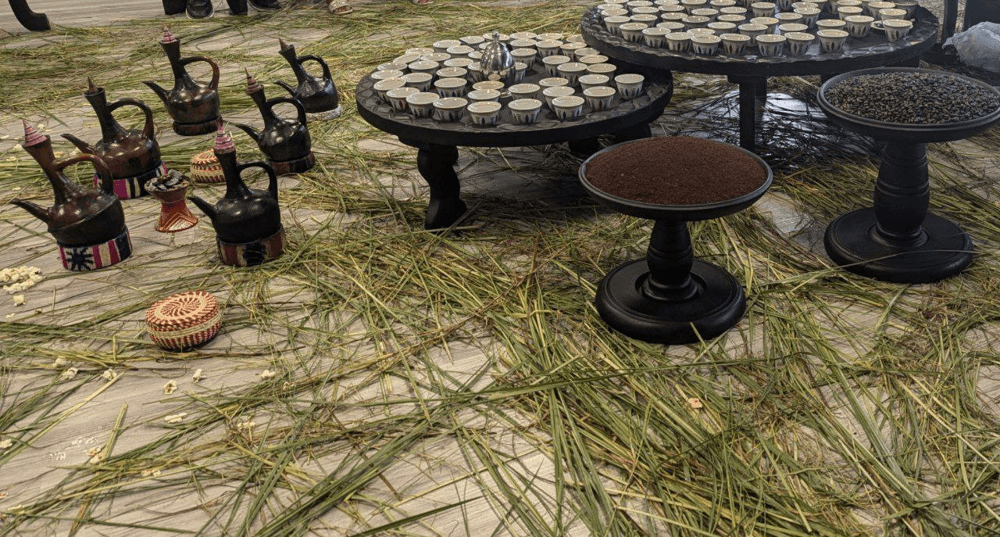
Traditional Ethiopian coffee ceremony setup, with a clay jebena pot and small cups. While coffee’s origin is Ethiopian, brewing the roasted beans into a drink became a tradition that flourished in Yemen’s Sufi monasteries.
Intriguingly, written records from the 15th–16th centuries give us specific clues about coffee’s first adopters. A prominent Arab historian named Abd al-Kadir al-Jaziri, writing in the 1580s, traced the spread of coffee and noted that a Yemeni Sufi scholar – Sheikh Jamal al-Din al-Dhabhānī, the mufti of Aden – was reportedly “the first to adopt the use of coffee (circa 1454)”. Al-Dhabhānī found that coffee drove away fatigue and lethargy, bringing him a alertness and vigor, which explains why it caught on among those with long hours of nighttime worship. In other words, by the mid-15th century in Yemen, people were regularly roasting coffee beans, grinding them, and boiling them to make a stimulating drink – essentially the same fundamental process we use to make coffee today.
It’s worth noting that Yemen has its own colorful legends about coffee’s origin that parallel the Kaldi tale. One popular Yemeni story credits a Sufi holy man, Ali ibn Omar al-Shādhilī (Sheikh Omar), with brewing the first cup of coffee around the 15th century. According to this legend, Sheikh Omar was exiled to a desert cave and, on the brink of starvation, he tried eating some wild coffee berries. Finding them bitter and hard, he roasted the beans in a fire, then boiled them in water to soften them – yielding a fragrant brown liquid that revitalized him. This “miraculous” drink sustained Omar for days, and when news of it reached the nearby city of Mocha, he was welcomed back from exile and even made a saint. Like most legends, the details of the story vary, but it aligns with the idea that Yemen’s mystics were among the first to unlock coffee’s secret as a brewed beverage.
From Yemen to the World
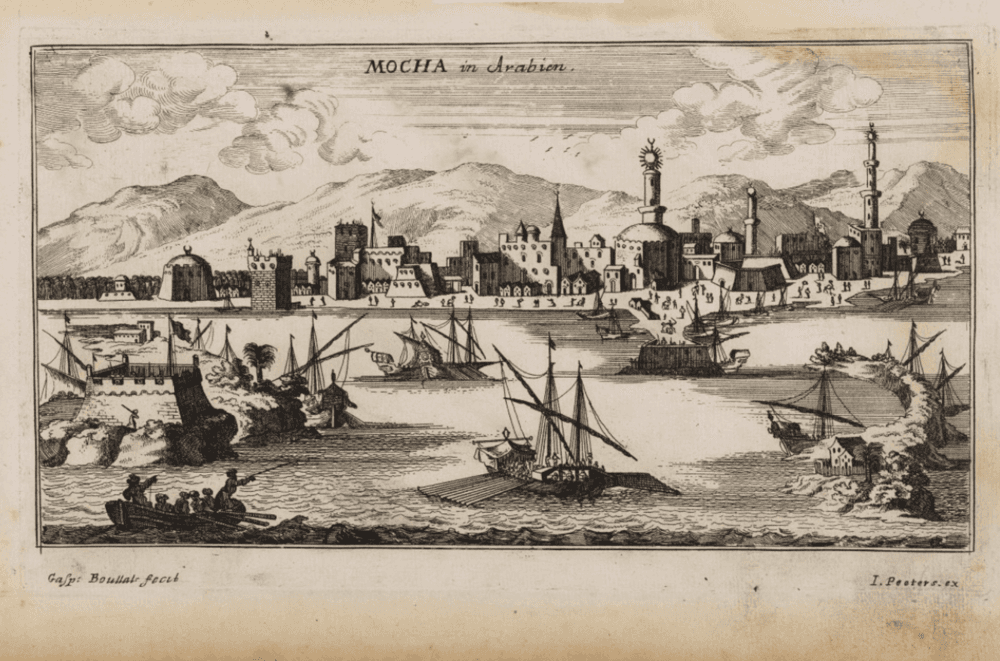
17th-century engraving of the port of Mocha, Yemen (circa 1690). Mocha was the hub of the early coffee trade, from which Yemen exported coffee beans – often already roasted – to prevent their cultivation elsewhere.
Once the Yemeni Sufis had established coffee as their beverage of choice, the practice of coffee drinking spread rapidly. By 1414, coffee was known in the holy city of Mecca, and by the early 1500s it had reached Cairo and other parts of Egypt and North Africa via Yemeni traders. Public coffee houses (called qahveh khaneh) began springing up in cities like Cairo and Damascus in the early 16th century, where people gathered to sip coffee and socialize – much as we might in a café today. The vibrant port of Mocha in Yemen became the world’s first center of the coffee trade. Throughout the 16th and 17th centuries, Mocha was virtually the only source of coffee for international markets, as the Yemeni exporters tightly guarded their prized crop (in fact, for a long time they forbade unroasted coffee beans from leaving the country, to ensure nobody else could plant them). From Mocha, the habit of coffee drinking traveled along trade routes to the Ottoman Empire, reaching Istanbul by the 1550s, and then onward to Europe by the 17th century. Europeans enthusiastically adopted coffee in their own cafes, ensuring that what began as a local custom in Yemen would become a global phenomenon in the centuries to follow.
In summary, the first people to drink coffee in a brewed form – much like we enjoy it today – were the Sufi mystics of 15th-century Yemen. While Ethiopia gave the world the coffee plant (and inspiring legends of dancing goats), it was in Yemen that coffee was first roasted, brewed, and consumed as a hot beverage. The Yemeni Sufis adopted coffee to help them stay awake during prayers, unwittingly sparking a caffeine-fueled social revolution. From those humble beginnings in Yemeni monasteries, the love of coffee spread across the Middle East and then around the globe. Next time you enjoy your morning cup, you can remember the curious monks and mystics – from the Ethiopian highlands to the Yemeni shrines – who first pioneered the cup of coffee as we know it today.